
How to Get More Fiber in Your Diet
If the idea of getting 25-32 grams of fiber a day sounds overwhelming or worse, like a recipe for bloating and discomfort; you’re not alone.
I used to feel the same way, especially after some bad run-ins with high-fiber snacks and bars. But when I made the decision to get serious about my gut health, I learned that getting enough fiber doesn’t have to be difficult or miserable.
With real food, a little planning, and a focus on variety, I now hit my fiber goals daily—and I feel better than ever.
If you know you need to eat more fiber but are confused about how much and what kind, this post will help. Here’s how to get more fiber in your diet with food.
I’m on my own journey of eating more fiber from food. I’ve had adverse reactions to high fiber bars or high fiber cereals, so I really want to get all my fiber from food in my diet.
According to Harvard Medical and most other sources, the dietary guidelines for women over 50 need about 25 grams of fiber per day. That doesn’t seem like a lot right?
But when you start looking at amounts, you might see that an apple has 4 grams of fiber or a cup of green beans has 3 grams.
So, it seems like you need to eat a lot of food to get all your fiber. However, in my journey to learn about fiber and eat more fiber, I’ve found it’s not that difficult to get my fiber in every day.
While there are many fiber supplements available to provide extra fiber, these can be harsh for some of us. I saw this as an opportunity to improve my overall nutrition as well since all fiber comes from plant-based foods.
As someone who writes about managing weight and provides private coaching for women over 50, I’ve mostly focused on a well-rounded diet, with plenty of protein, carbs, and healthy fats and not eating around the clock.
I recently decided that I needed to be more intentional about getting enough fiber in my every day diet.
To do that, I began by looking up what foods were considered high in fiber and how much fiber was in common foods I was already eating.
Within two days, I began losing weight and feeling better. Even though I was eating fiber rich foods, I felt less stuffed and bloated.
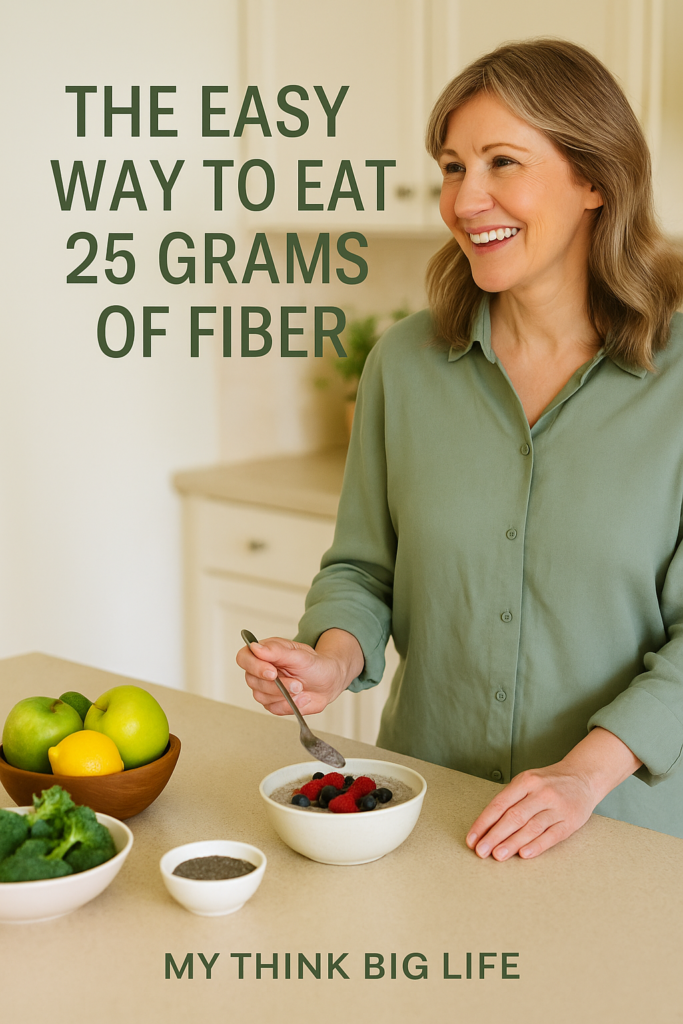
When i first looked at how much fiber was in common foods, I was discouraged. Looking at three grams here and four grams there made it seem like it would be difficult to consume enough fiber to reach my fiber goals.
According to the NIH, the amount of fiber a woman my age needs is 25 grams of fiber every day. To get enough, I decided to eat three meals and include a variety of foods.

What Are the Types of Fiber?
There are two main types of fiber: soluble and insoluble and you need them both.
As their names suggest, one dissolves and the other does not. Soluble fiber breaks down and becomes a gel like substance. Insoluble fiber does not and passes through your digestive tract without breaking down.
Soluble fiber has several benefits. But in terms of your weight, I’d say these are the most important three:
- Slows down fat absorption
- Can stabilize blood sugar levels
- Feeds your gut bacteria
In more broad health benefits, fiber is also shown to lower risk in several areas such as cardiovascular health and some types of cancer.
Insoluble fiber keeps everything moving, meaning it helps you be regular prevents constipation.
Fiber is fairly easy to incorporate into your diet with common foods. Some common sources are:
- Berries and other fruit
- Avocados
- Chia and other seads
- Oatmeal and other whole grains
- Vegetables
- Beans and lentils
- Whole grains
In general, many types of produce and grains have both types of fiber. Most people could use more high fiber foods in their diets.
As you focus on fiber, you will naturally get more vegetables, fruits, grains, and other plant-based foods into your diet.
Since these foods also have huge nutritional benefits, getting more fiber means getting more nutrition.
What Foods Are Naturally High in Dietary Fiber?
Here is a short list of some high fiber foods. But keep in mind that fiber adds up, so you don’t just have to stick to high fiber foods. Foods that have two or three grams of fiber will add up as you eat throughout the day.
But I do like to have a couple of higher fiber foods to help me meet my overall goal for daily fiber.
Chia Seeds are one of my favorite high fiber foods. I mix them with cashew milk, a little sweetener, and vanilla and it makes a pudding that I can add berries to. It’s an excellent breakfast or even a treat.
I also blend it into mashed berries to make a jam like topping for yogurt. Chia seeds can also be blended into smoothies. While high in fiber, chia seeds (eaten in moderation and soaked) do not upset my digestive system at all. However, I also don’t overdo on them.
Beans and lentils have lots of fiber as most of us know. I wasn’t eating many beans before I got into learning about my fiber intake, but once I saw how much fiber they had, I decided to start working them in.
I keep my portion size to about 1/2 cup a day. I will have them as a side dish or add them to a salad, soup, or other dishes.
Fruits and vegetables all have some fiber. To get the most fiber from them, be sure and eat the skin or peel when possible because that can be where most of the fiber is in some foods. You’ll also get the most nutrients that way.
How to Avoid Problems with Too Much Fiber
Bloating, cramping, and gas are the most reported problems people have with fiber-rich foods. Moderation is key here.
If you have not been getting enough fiber, go easy on it. You can make yourself more miserable if you overdo it in the beginning.
Remember, fiber is going to directly affect your digestion and your bowels. This can be a positive experience if you take it slowly.
Adding fiber to your diet is to not just affect your right now, but ideally to affect your long-term health.
A high-fiber diet is ultimately good for you. But if your system isn’t used to a high-fiber diet, work your way up. It’s better to start with smaller amounts and see how your digestion is affected.
For me, I’ve found that eating a lot of variety and not depending on just the very high-fiber foods has given me the benefits and none of the problems.
Actually, my gut feels so much better since increasing my overall fiber using food.
What I mean by that, is eat the really high fiber foods in small quantities. Half a cup of legumes probably won’t cause a problem. But eating two cups may put your bowels in distress.
Also, you don’t have to go crazy. Go for the recommended amounts. If the amount recommended for you is 25 grams, work on getting that amount in. Don’t aim for 50 grams to start.
The Benefits of Getting Enough Fiber in Your Diet
Blood sugar levels
This is not medical advice here since blood sugar levels are serious. However, from what I’ve read, sufficient fiber is beneficial in regulating blood sugar levels. While carbohydrates do raise blood sugar, eating carbohydrates that also have fiber can help off-set this.
Better gut health
Probiotic and prebiotic foods and drinks are popular because it is recognized that gut health is important. You can also feed your gut by eating a wide variety of plant-based foods.
Research shows that people who eat a fiber-rich diet, also have a healthier gut biome. In addition to not being a doctor, I’m also not a scientist. But having a healthy gut is really important to overall health.
Lower risk of other health problems
Remember, fiber is just one aspect of a healthy lifestyle and diet. However, it’s a really important one. According to Harvard Health, eating sufficient quantities of fiber can lower your risk of dying from heart problems, stroke, colon cancer, and diabetes.
Losing weight
Fiber slows digestion and helps you feel full. Fiber provides bulk to your diet. What I mean by that is you feel like you are eating more and it fills you up.
This is helpful because you feel more comfortable because you won’t feel hungry. The bulk gives you that full feeling.
Better nutrition
When you eat more foods that are plant-based and have fiber, you naturally increase the amount of minerals and vitamins in your diet.
Whole food provides so many benefits. While most of us supplement ( I do, so I’m not putting that down) the nutrients in whole food is complex and you get the benefits of all the micro nutrients too.
Foods That are Great Fiber Sources
I recommend you look up foods that are good for getting fiber online and develop a list of foods you can have on hand to get you started.
This helped me immensely to have a go-to list. I plan my fiber needs for each day and then add in my protein and fat around that.
Okay, this list is some of my favorites. It’s easy to look up foods and fiber content so you can make your own list. This is just an example of how I’m doing this.
Chia seeds are a food I love to use and now I’m more intentional about it.
Avocados. I love avocados and was happy to see they are also high in fiber.
Berries. I love all berries and keep a variety in my freezer to add to yogurt, my chia pudding, or on their own. Raspberries are especially considered a good source but enjoy them all: blackberries, strawberries, and blueberries.
Beans. I try and add 1/2 cup of beans to my diet every day. For example, black beans have 8 grams of fiber in 1/2 cup. That’s almost a third of my daily needs.
Vegetables and fruits. I like to have a variety of vegetables every day. I mix it up every week. Since I live alone, I usually buy of few different vegetables each week to eat. Try for lots of different colors and types.
Whole grains. I don’t eat many whole grains. Wheat is a problem for me so I avoid it. Many people swear by oatmeal and it is considered a good source of fiber.

Tips on How to Eat More Fiber in Your Diet
Eating more fiber in your diet doesn’t have to be a chore or boring. For me, knowing all the benefits made me excited to eat more fiber.
I would say, it’s actually made my diet not just healthier but tastier too. Eating more fiber, naturally makes a significant portion of your diet plant-based.
You get the health benefits plus, if you go for variety, you will probably feel better too. Eating foods that focus on fiber, has really helped my digestion and how my gut feels.
I think a great gut is one that I don’t feel! And counter-intuitively adding more natural fiber has me not feeling any digestive problems.
To sum it all up, here are my tips.
Do a little research about foods high in fiber. Pick a some that are on the high-side to have a small amount of daily. For me, these are chia sees, beans, and avocados.
Then make a list of serving sizes of foods you like, and how much fiber each food has.
Each day, put together a list of foods you’re going to eat that add up to about 25 grams of fiber.
Here’s a normal day for me now.
Chia pudding (10g) with blueberries (2g) (12 grams)
Salad (1g) with chickpeas (5g), chicken, and roasted carrots (2g) (8 grams total)
Meatballs (4 g from oats) with zucchini (2g) noodles, and tomato sauce (2 g) (8 grams total)
That gives me 28 grams for the day!
Meeting your nutritional and dietary needs is doable with some planning and commitment. Based on what I’ve learned, I really believe getting enough fiber is important to feeling good and also improving my overall health.

Keep showing up my friends,
Sara
Start feeling better today!
Check out what life coaching can do for you
Coach with Sara

I'm a personal life coach for midlife women who want to feel better. Isn't that what we are all looking for? My job is to teach you how to get your mind aligned with your body and spirit, so you actually do feel better, with skills you can use forever.
Let's get started today!
Start your change today by signing up for a free zoom consult. I can't wait to meet you!